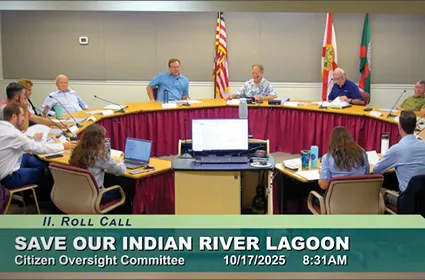
October 2025 Save Our Lagoon Citizen Oversight Committee Meeting Highlights
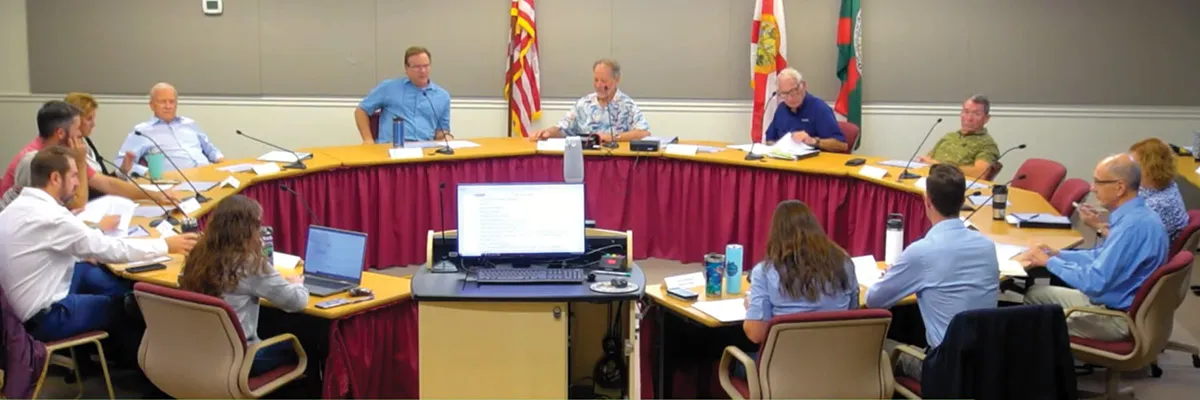
The Save Our Indian River Lagoon (SOIRL) Citizen Oversight Committee (COC) met on October 17, 2025, at the Brevard County Government Center in Viera. The committee reviewed fiscal updates, restoration progress, and current research focused on oyster and seagrass recovery efforts throughout the Indian River Lagoon.
Program Progress and Fiscal Report
SOIRL staff reported continued project implementation and community participation across Brevard County. To date, 112 community projects and 2,227 homeowner projects have been completed under the SOIRL Project Plan.
Key project milestones this month included:
- Septic Upgrades: 17 additional homeowner upgrades processed, totaling 564 completed to date and 876 agreements executed.
- Quick Connects: One additional connection reimbursement, with 512 completed and 555 agreements executed.
- Derelict Vessel Removal: Three vessels removed.
- Grand Canal Muck Dredging: Over 534,000 cubic yards of material dredged, with completion expected by the end of November.
- Sykes Creek T Septic-to-Sewer Project: Pump station foundation poured; line installation nearing completion.
- Stormwater Basin Retrofits: Active construction at multiple sites including Basin 1280B (Flamingo Drive) and Basins 1263, 1335, and 1349 (Wickham and Conservation Place).
Financial Overview
Fiscal Analyst Lori Pierce reported that total program revenue since inception has reached $484 million, with $457 million collected this fiscal year—representing 88% of projected annual revenue. Expenditures for FY2025 total $33.7 million, primarily directed toward capital improvement and intergovernmental restoration projects.
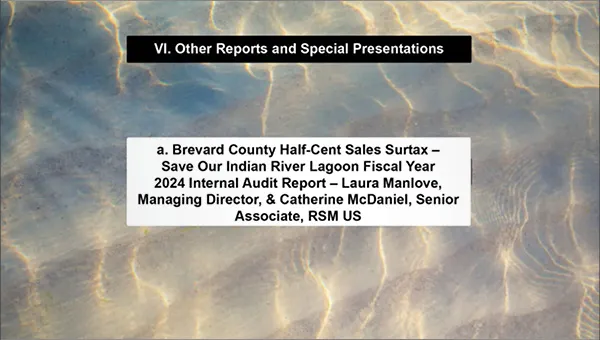
Representatives from RSM US presented the results of the FY2024 Save Our Indian River Lagoon Internal Audit. The auditors confirmed no errors for the fiscal year. Approximately 49% of total expenditures were reviewed across 19 active projects, with all procurement and expenditure practices found to be correctly recorded and compliant with county and state requirements.
In addition to fiscal and project updates, the committee heard several scientific presentations highlighting research that informs the lagoon’s ongoing restoration strategies.
Research and Project Presentations
Oyster Restoration and Research Updates
The committee received multiple presentations from research partners on advances in subtidal oyster restoration.

Tyler Provoncha, Conservation Manager for the Brevard Zoo’s Restore Our Shores program, reviewed more than a decade of oyster restoration in Brevard County. His presentation outlined how materials have evolved from early mesh bag designs to current coquina corral reefs that use natural stone and oyster shell.
Restoration efforts have now expanded to over 100 reef sites countywide, with some reefs exceeding 1,400 oysters per square meter—well above minimum success criteria.
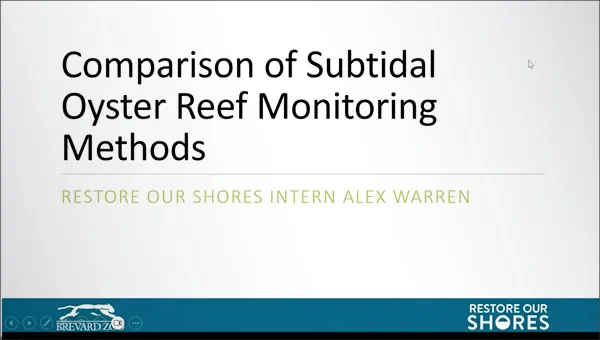
Alex Warren, University of North Florida intern with Restore Our Shores, compared monitoring methods for different reef types. His analysis showed that coquina coral reefs demonstrated the highest oyster densities and provide consistent, repeatable monitoring results.
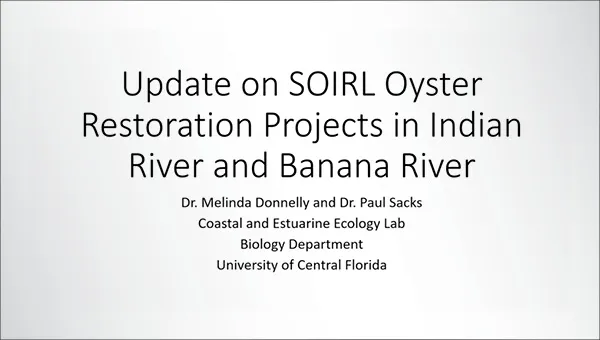
Dr. Paul Sacks, University of Central Florida, presented monitoring data from multiple active sites, including Rainwater Point and Turkey Creek. Both showed sustained oyster recruitment and densities meeting the county’s “sustaining success” criteria for long-term reef establishment.
Seagrass Restoration Experimental Design
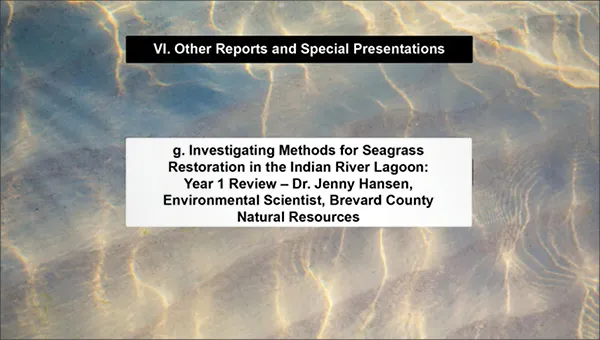
Seagrass provides essential habitat and food sources for species such as manatees, fish, and invertebrates. Understanding which planting techniques perform best helps researchers identify restoration methods suitable for different parts of the lagoon.
Dr. Jenny Hansen, Environmental Scientist with Brevard County Natural Resources, presented Year 1 findings from the Seagrass Restoration Experimental Design project.
The study, located in Titusville and Melbourne Beach, tests several transplanting and protection methods to evaluate which combinations best support seagrass recovery in local conditions.
After one year, the Titusville site demonstrated notable regrowth—reaching 20% seagrass cover in restored plots—while the Melbourne Beach site experienced limited recovery, likely due to turbidity and sediment differences. Monitoring and data collection will continue through 2026 to assess long-term trends.
Videos Presented During the Meeting
Oyster Bar Monitoring
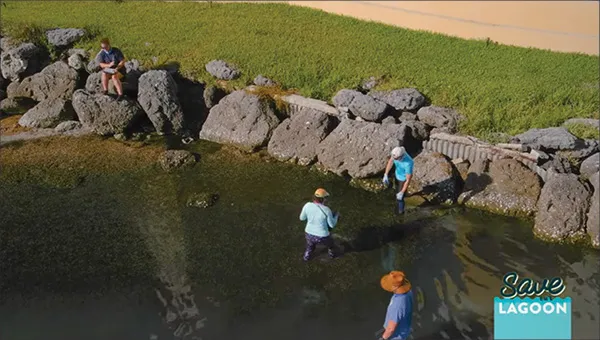
This video highlighted collaborative monitoring of oyster reef projects between Brevard Zoo’s Restore Our Shores team and the University of Central Florida’s Coastal and Estuarine Ecology Lab.
It showed researchers pulling sample bags from reef sites, counting live oysters, and documenting associated species such as barnacles and small crabs.
The footage demonstrated how oyster reefs serve as “ecosystem engineers,” filtering water and forming three-dimensional structures that support marine biodiversity. Monitoring data from these efforts help evaluate the performance of reef designs over time.
Seagrass Restoration Experimental Design
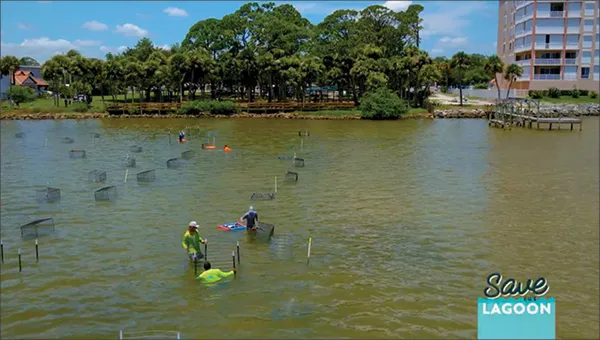
This video provided an overview of the Seagrass Restoration Experimental Design project at William J. Manzo Memorial Park in Titusville.
It featured scientists installing peat pot and plug transplant units and deploying underwater sensors to monitor light, temperature, and salinity. The video explained how these trials help determine which planting methods perform best under lagoon conditions and highlighted seagrass’ role in stabilizing sediments and supporting marine life.
Public Engagement and Upcoming Events
Alongside research and infrastructure updates, staff shared recent community outreach and educational efforts, including the Oyster Gardener Workshop, National Night Out in Titusville, and Indian River Lagoon Day.
Upcoming events and opportunities include:
Lagoon Science Forums and Public Events:
October 29-30 – Marine Resources Council Low Impact Development Conference
Volunteer Opportunities:
November 7 – Marine Resources Council First Friday Litter Patrol
November 14 – Marine Resource Council Mangrove Workshop
Ongoing volunteer opportunities:
- Brevard Zoo Restore Our Shores – Email for current volunteer sessions
- Florida Horseshoe Crab Watch – contact Holly Abeels for details
- ORCA Pollution Mapping and Pyrodinium Analysis – Contact Lauren or Kathy
- Rotary Park Storm Drain Marking and Rain Garden Maintenance – Contact Carlos Cuevas
- Surfrider Foundation Blue Water Task Force Monitoring – contact Chris Baker for participation details
New Business
The committee unanimously approved the 2026 meeting calendar, maintaining the standard monthly schedule with no June meeting. Staff also noted that 15 project applications for the 2026 Plan Update will be reviewed at the next meeting in November.
Summary
The October 2025 meeting reflected measurable progress in ongoing lagoon restoration, transparent financial management, and expanded research collaboration across local agencies, universities, and partner organizations.
Presentations and monitoring updates provided insight into how scientific data are being used to evaluate restoration success and guide future project planning for the Indian River Lagoon.
Watch the Full Meeting
To view the complete October 2025 Citizen Oversight Committee meeting and presentations:
📺 Facebook: facebook.com/share/v/1FSCN9UKYp
📺 YouTube: youtube.com/watch?v=YoOZ-nuV2LQ